BORROWED LIGHT - OPEN LECTURE
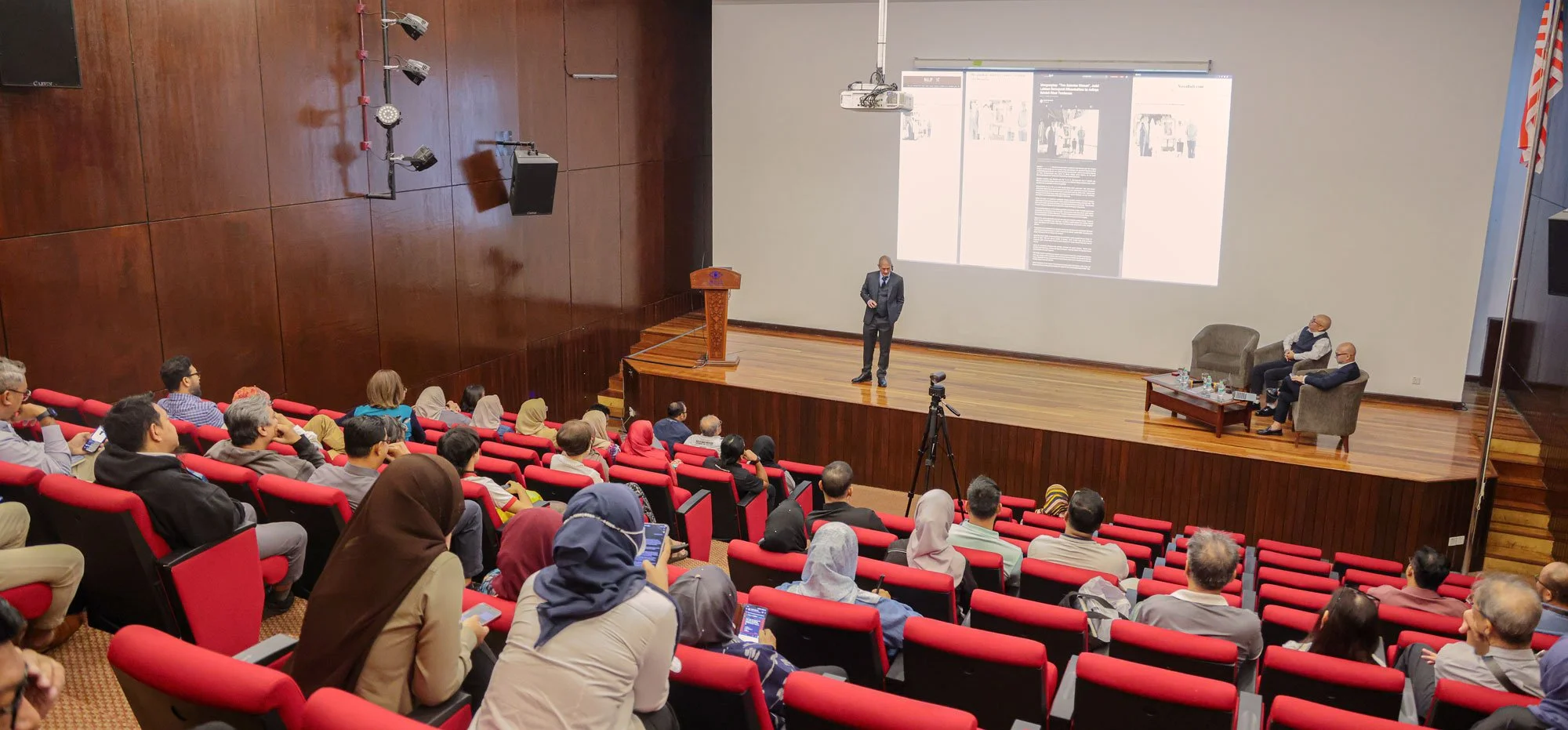
The open lecture delivered on February 11th 2026 at National Art Gallery (Malaysia) was not merely a presentation of research; it was a ritualistic exhumation of a narrative long buried under the strata of colonial misattribution. Centred on the project Borrowed Light: Shadows of Wanita Sulawesi, the session functioned as a critical exegesis of a single archival "rupture"—the moment a name is returned to the nameless. The lecture explored how a century of looking can result in a profound failure to see, and how forensic inquiry can be an act of surgical resurrection of identity.
At the heart of this inquiry is the concept of "Borrowed Light." In the darkroom of history, the subjects of the painting formerly known as Wanita Sulawesi existed as ghosts, illuminated only by the original creator’s lens and the painter’s subsequent misinterpretation. They were trapped in a state of modernism exoticism—a colonial convenience that stripped them of their specific Perak royal lineage and recast them as generic figures from Indonesia. The lecture dismantled this shadow-play, revealing that the "light" borrowed by the painter, Jan Frank Niemantsverdriet, was harvested from a 1908 colonial publication, Twentieth Century Impressions of British Malaya.
The weight of the lecture rested on the physical board itself. Through infrared photography and a deep search of the archives, the investigation pierced the "skin" of the painting to reveal a hidden witness: a faint signature and the original Dutch title, Twee Bataafse Vrouwen (Two Batavian Women). This discovery was the catalyst for the re-titling ceremony at the ARMA Museum in Ubud, Bali. It proved that the work was not an original observation of Sulawesi life, but an appropriation of a G.R. Lambert & Co. photograph from 1908 published works. In this moment of forensic revelation, the painting ceased to be a static object of art and became a site of struggle between the state's record and the subject's truth.
The lecture further traced the "Third Space" of this image’s genealogy—moving from the G.R. Lambert & Co.’s image in the early 1908 to the 1984 silk-screen work of Redza Piyadasa, Two Malay Women. This layering of visual culture demonstrates how an image is never a closed circuit; it is a vibrating interval that carries the "breath" of the subject across decades of colonial and postcolonial intervention. By reconnecting the painting to its authentic roots in the Perak royal court, the project performs an act of decolonising the lens, ensuring that the subjects are no longer silent participants in a "borrowed" history.
Ultimately, the session at Balai Seni was a manifesto for the sanctity of the gaze. It asserted that to name a thing correctly is to allow it to exist fully. By exhuming the breath, " Borrowed Light ensures that these women are no longer seen through the lens of surveillance or exoticism, but are acknowledged in their simple, haunting dignity. The lecture concluded not as a finality, but as a vibration: a reminder that the archive is found in the persistent effort to return a name to its rightful title.
The Provenance of the Shadow: A ChronologY
The Genesis Discovery (c. 1900): The G.R. Lambert & Co. photograph is taken, documenting the noble ladies of the Perak Royal Court—a moment of specific, localised documentation.
The Publication (1908): The image is published in Twentieth Century Impressions of British Malaya, becoming a tool for colonial propaganda and economic expansion.
The First Painting (c. 1920-30s): Jan Frank Niemantsverdriet utilises the published photo as a reference, misidentifying the subjects and creating the work that would later be titled Wanita Sulawesi.
The Appropriation (1984): Redza Piyadasa utilises the layered history of the image to create Two Malay Women, acknowledging the friction between the archival record and the artistic interpretation.
The Reclamation (2025): The forensic identification of the signature and the ceremonial re-titling to Twee Bataafse Vrouwen at the ARMA Museum in Bali, restoring the cultural and spatial context of the subjects.